
News · Explainer
How did Baron Coleman use Google Trends, and how is that different from Ana Escobar?
Both read Google Trends charts from before the Charlie Kirk shooting. Coleman compared regions, checked a long baseline and declined to conclude. Escobar reads spikes as a visitor log. Neither result is conclusive.
By Americans for Transparency · Published
The short answer
They used the same tool to reach different kinds of claim. Baron Coleman compared regions, checked a 13-month baseline, and said repeatedly that he did not know who searched or what it meant. Ana Escobar reads spikes on names in one metro area as a record of who visited Fort Huachuca. Coleman's approach is the more careful one. It still cannot show that a search happened, because of how Google builds the charts.
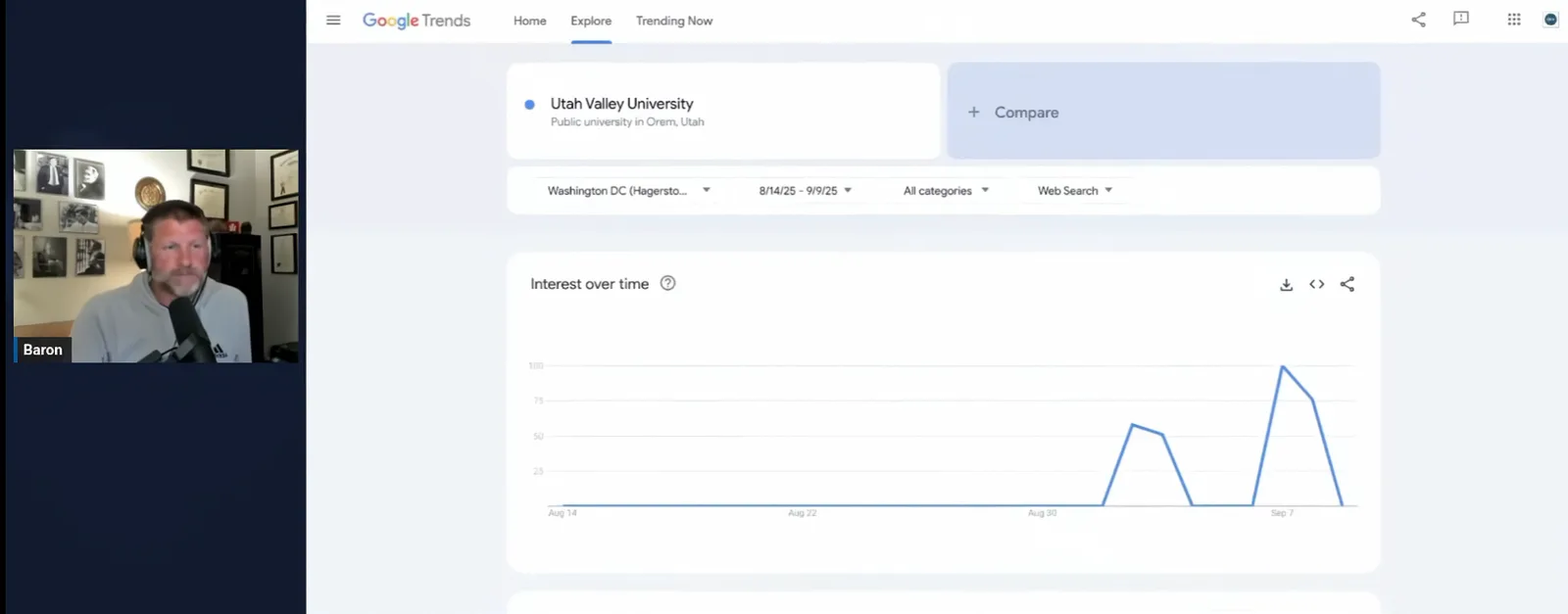
- Coleman showed his searches live in a September 2025 stream and told viewers he was making "no allegation of fact other than what I can show right here."
- He ran the same terms in several regions, checked a 13-month baseline and gave the innocent explanations himself. Escobar searches one metro area and names who she believes the spikes show.
- One thing they share: both set date ranges that end before the shooting, and both searched many terms without saying how many showed nothing.
- Those checks narrow the room for coincidence. They do not remove it. Google says one-off spikes on low-volume terms can be noise.
- When one of his results vanished on air, he asked whether it was being cleaned up. Google's sampling explains a changing chart without anyone deleting anything.
- Two people who re-ran his searches, one a critic and one who promoted his work, say they could not reproduce them. Coleman concluded the results had been wiped.
Who they are and what each did
Baron Coleman is a Montgomery, Alabama attorney and broadcaster. On a stream published September 15, 2025, five days after Charlie Kirk was shot, he ran Google Trends searches on air for terms tied to the case. A 16-minute cut of that stream was republished on September 24, 2026.[1][2][3]
Ana Escobar's work is different in subject and in claim. She searches the names of officials in the television market around Fort Huachuca, Arizona, and reads the spikes as a list of people who visited the base. AFNPT reviewed that claim in full.[4]
What Coleman showed
| Search term | Region | Date range | What he pointed to |
|---|---|---|---|
| Utah Valley University | Washington, D.C. metro | Aug 14 to Sep 9, 2025 | Flat for about three weeks, then a rise in early September and a peak of 100 on September 7. |
| "losee center" | Huntsville-Decatur, Alabama | Aug 14, 2023 to Sep 6, 2025 | One spike to 100 in spring 2025. Nothing else in two years. |
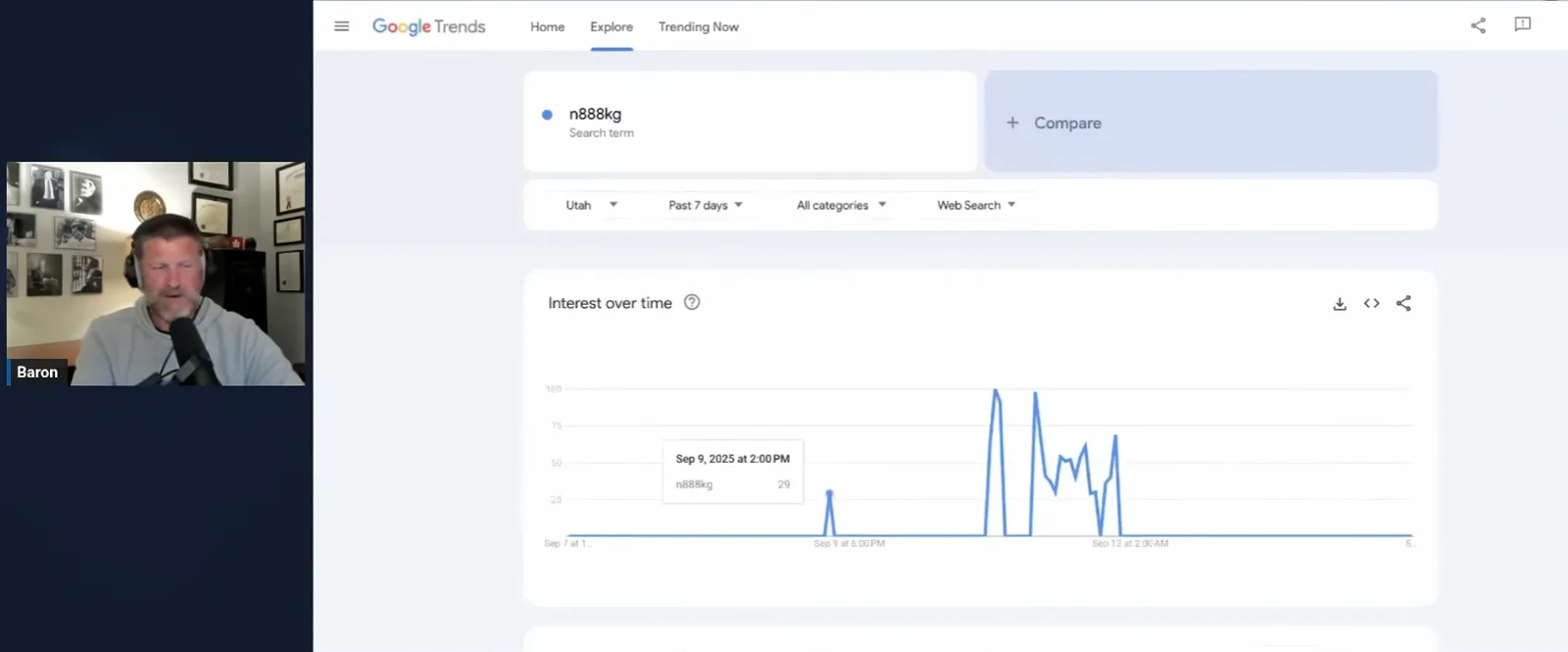
| n888kg | Utah | Seven days around the shooting | A point of 29 at 2:00 p.m. on September 9, then large spikes after the plane was in the news. |
| "tyler james robinson" | Huntsville-Decatur, Alabama | Seven days around the shooting | A single spike to 100 before the shooting. |
| The name of a man publicly linked to the company that owns the plane | Utah; Washington, D.C. metro; Huntsville | Seven days around the shooting | Single points between September 7 and the morning of September 10, before the plane was in the news. |
| The name of the defendant's roommate, who is not charged with anything | Washington, D.C. metro | Aug 2021 to Sep 2025 | Two spikes in 2023. |
How the two methods differ
| Baron Coleman | Ana Escobar | |
|---|---|---|
| What is concluded | Nothing, by his own account. He says he does not know who searched or what it means. | That the people named visited Fort Huachuca, and that an Army AI system made the searches. |
| Regions | Several, compared with each other: Utah, Arizona, Huntsville, the Washington metro area, the District of Columbia. | One: the Tucson (Sierra Vista) television market, which covers most of southern Arizona. |
| Search type and terms | Web Search, on plain names and a tail number. | Image Search, on long constructed phrases. |
| Date range | Ends before the shooting. For the tail number, 13 months of baseline. | January 1 to September 9, 2025. Also ends before the shooting. |
| Alternative explanations | Stated on air, each time. | Sometimes qualified with "allegedly" or "in my opinion." |
| How many searches were tried | Not stated. He says he "looked a lot of places." | She says "hundreds and hundreds," and kept 43. |
The first row is the one that matters most. Coleman presents the charts as leads to be checked. Escobar presents them as a guest list. A chart of sampled, scaled search interest can support the first use far better than the second.[3][4]
Coleman also explained why he cut the days after the shooting out of his date ranges. Every term tied to the case shot up after September 10, and he wanted to know whether he was looking at statistical noise around the event. For the tail number he went back 13 months in the Washington, D.C. area and reported no interest until about a week and a half before the shooting.[3]
“No allegation of fact other than what I can show right here.”
The record is not one-sided on Escobar. AFNPT's review notes that she described Trends as a sampling method herself, that she warned a plain common name proves nothing, and that her date range also leaves out the post-shooting surge. Where the two part ways is in what they say the spikes show. Where she has a point.[4]
When AFNPT ran control terms with her settings, invented and cartoon names produced spikes on her dates. When her own searches were re-run, none of the 31 terms with a known date came back within a day of it.[4]
Why his results are still inconclusive
Coleman's checks answer one objection: that the spikes are just the echo of the news. They do not answer the larger one. On a term that almost nobody searches, Google says a spike can appear with no real search behind it.[6]
“These apparent one-off spikes should not be interpreted as real search activity or evidence of individual searches.”
Several of his findings are exactly that shape: one point, on a rare term, in one metro area. A long flat baseline does not make such a point more reliable. Rare terms are where the noise shows most.[6][7]
Looking in many places also matters. Coleman told viewers he "looked a lot of places." The more terms and regions anyone tries, the more isolated points they will find. In AFNPT's tests with Escobar's settings, about one rare or made-up phrase in three showed a spike somewhere. That rate was measured with her settings, not his, so it is a guide and not a measurement of his searches.[3][4]
The seven-day charts add a further limit. Google says charts of seven days or less use the viewer's own time zone. Coleman broadcasts from Alabama and the shooting was in Utah, so the hours on his screen would be Central time unless his device was set otherwise.[6]
The moment a result disappeared
Near the end of the segment Coleman re-ran a search and the result he had shown was no longer there.[3]
“It has changed. Are they cleaning it up on the fly?”
He returned to it in a follow-up stream. A friend had called to say the searches could not be reproduced. Coleman said he tried again with the same dates and regions and found that most of them no longer appeared.[8]
“They're wiped. The only conclusion I could draw is they were wiped.”
There is a documented explanation that does not involve anyone removing data. AAP FactCheck reported that Google draws a different random sample each time a query is run, and that for uncommon terms the same search on a different day can give a noticeably different chart. AFNPT saw the same thing in its own tests: searches run hours apart returned different dates.[9][4]
This is the point where a careful method and Google's design collide. A result that cannot be reproduced can be read as proof of tampering or as proof that the first result was noise. The chart cannot tell you which.
What critics have said about Coleman's work
Gary Melton, who publishes as Paramount Tactical, said in a November 2025 video that he entered every one of Coleman's searches with the same settings and never reproduced a result.[10]
“Google Trends data changes because it's continually recalculated, renormalized and sampled, not because Google is changing history.”
James Li, whose October 2025 video carried Coleman's charts to a wider audience and praised his research, told his own viewers: "Full disclosure, I did try to replicate these search trends, but I could not." Li then relayed claims that the results had been scrubbed, and also read out an explanation that sampling and normalization are overwhelmingly the likely cause.[11]
A write-up that was otherwise sympathetic to Coleman's segment conceded two points: that nothing ties the searches to government offices or media insiders, and that Google's regional scaling can make a small number of searches look large. Distractify, covering the same charts as shared on TikTok, said it checked Google Trends and did not find the searches, and called the theory unproven.[12][13]
Jacques Raubenheimer, a University of Sydney biostatistician who studies Google Trends, used the accused man's full name as a worked example of how rare terms produce isolated spikes. He did not name Coleman.[7]
AFNPT found no report by a wire service or fact-check desk that examines Coleman's charts directly, and no independent reproduction of them, as of October 13, 2026.
Where Coleman's own framing goes further than his caveats
Coleman's caveats are real and frequent. So is a second thread in the same segment. He told viewers he was about to show "the fact I think that could put it all together for people who want to draw a conclusion," and asked what else he would need to search "if I'm plotting an assassination." At one point he referred to "the roommate of the assassin" without the word alleged. Tyler Robinson is charged, has pleaded not guilty and is presumed innocent.[3][14]
That does not undo the method. It is a reason to separate what he did, which was careful, from where the segment points, which the data cannot support.
The fair summary
Coleman treated the charts as leads and said so. Escobar treats them as a record. On method, that is a large difference, and it is to Coleman's credit. On what the charts can prove, there is no difference. Without the search counts that only Google holds, a pre-event spike on a rare term is consistent with one real search, with several, or with none.
Questions people ask
Did Baron Coleman claim Google Trends proves foreknowledge of the Charlie Kirk shooting?
Not in the segment AFNPT reviewed. He said he was making no accusation, that the results might be coincidence, and that he did not want to draw a conclusion. He also framed some results as what could "put it all together" for viewers who did.
Is Baron Coleman's Google Trends method better than Ana Escobar's?
It is more careful. He compared regions, checked a long baseline, stated the innocent explanations and declined to conclude. She names who she believes the spikes show. Neither method can show that a specific search happened, because Google Trends reports sampled, scaled data with added noise.
Why could other people not reproduce Baron Coleman's searches?
Google Trends draws a new sample for each request, and results for low-volume terms can change from one run to the next. A critic says he re-ran every search and reproduced none, and a commentator who promoted the charts says the same. Coleman concluded the results had been wiped.
Has anyone confirmed the searches Baron Coleman showed?
AFNPT found no independent reproduction of his Washington, D.C. or Huntsville charts as of October 13, 2026. Only Google holds the underlying counts.
Sources
- [1]Yellowhammer News (Jeff Poor), Montgomery talker Baron Coleman out at News Talk 93.1 WACV for possible new radio gig, September 13, 2019. News report“Coleman, also a practicing attorney and political operative, departed WACV after a five-year run”
- [2]Baron Coleman (YouTube), DISTURBING Google Searches BEFORE Charlie Kirk Shooting - #1, September 15, 2025. Primary record
- [3]Baron Coleman Clips (YouTube), They Searched The Building 2 Days BEFORE Charlie Kirk Was Shot, September 24, 2026. Primary record
- [4]Americans for Transparency, The Fort Huachuca guest list, checked, October 7, 2026. AFNPT review
- [5]Fox News, FBI Director Kash Patel says agency investigating 'theories and questions' surrounding Charlie Kirk's murder, September 21, 2025. News report
- [6]Google, FAQ about Google Trends data. Official source
- [7]The Conversation (Jacques Raubenheimer, University of Sydney), How misreading Google Trends is fuelling Bondi attack conspiracy theories, December 17, 2025. News report
- [8]Baron Coleman (YouTube), MORE Disturbing Searches from BEFORE Charlie Kirk Passed Away - #2. Primary record
- [9]AAP FactCheck, Bondi attacker search data is static, not a conspiracy, December 24, 2025. News report“Google draws a different random sample each time a user runs a query.”
- [10]Paramount Tactical (YouTube) (Gary Melton), Google Trends is not a Historic Record., November 13, 2025. Public post
- [11]51-49 with James Li (YouTube), Charlie Kirk Shooting — They Knew BEFORE It Happened?!, October 14, 2025. Public post
- [12]GunsAmerica Digest, Charlie Kirk Conspiracy: They Knew It Was Going Down..., October 16, 2025. Reference“there is no confirmed evidence that these searches came from government offices or media insiders”
- [13]Distractify, Wild Charlie Kirk Google Trends Conspiracy Theory Raises Major Red Flags, October 16, 2025. Reference“We checked, and it does not appear to be evident in the search history.”
- [14]Americans for Transparency, State of Utah v. Tyler Robinson: the seven charges and where the case stands, October 13, 2026. AFNPT review