
News · Fact Check
Do Google Trends spikes before September 10, 2025 show someone knew about the Charlie Kirk shooting?
Google says a one-off spike on a rarely searched term is not evidence that anyone searched it. Independent checks reproduced the same pattern with unrelated terms. The charts cannot settle the question either way.
By Americans for Transparency · Published
The short answer
No. A Google Trends chart cannot show that. Google says spikes on rarely searched terms "should not be interpreted as real search activity or evidence of individual searches." Fact-checkers and a University of Sydney biostatistician reached the same conclusion about this kind of claim. The charts do not prove that nobody searched, either. They are the wrong tool for the question.
- Google Trends shows a sample of searches, scaled from 0 to 100 within the window you pick. It does not show how many searches were made or who made them.
- Google says it adds statistical noise, and that the noise is most visible on terms with little or no search interest.
- AAP FactCheck and ABC News in Australia tested the same kind of claim after the Bondi attack. ABC got pre-attack spikes for Mongolia, Japan and Kenya.
- The FBI director said the private plane named in these posts did not turn off its transponder.
- One point favours the people making the claim: Google added its written warning about noise in spring 2026, after the shooting.
The claims, and what the record shows
Claim 1 · Widely shared posts on TikTok, X and YouTube
Google Trends shows that people in the Washington, D.C. and Huntsville, Alabama areas searched for the accused man's name, the building and a plane's tail number before the September 10, 2025 shooting, which means someone knew it was coming.
Not supportedThe charts are real screenshots of a real tool. What they cannot do is show that a search happened. Google's own help page says one-off spikes on low-volume terms can be statistical noise. Trends also draws a new sample each time, so the same search can return a different chart. A single point at 100 means it was the highest point in that window, not that it was large.[1][2][3][4]
Claim 2 · Ana Escobar
Spikes on officials' names in Google Trends are a log of who visited Fort Huachuca.
Not supportedGoogle Trends reports interest by metro area, not by building or base, and does not record visitors. AFNPT re-ran her searches with her settings and ran about 1,600 control searches. Invented and cartoon names produced spikes on her dates. About one rare phrase in three showed a spike somewhere in the window.[5][1]
Claim 3 · Widely shared posts on X and Facebook
A private plane, tail number N888KG, turned off its transponder after leaving Provo on the day of the shooting.
Not supportedFBI Director Kash Patel said on September 21, 2025 that investigators interviewed the pilot, consulted the FAA and found the transponder was not turned off. He said incomplete flight data in rural areas caused the apparent gap. Lead Stories reported that the plane's owner described a prescheduled flight to Page, Arizona, with two pilots and no passengers.[6][7]
What the posts show
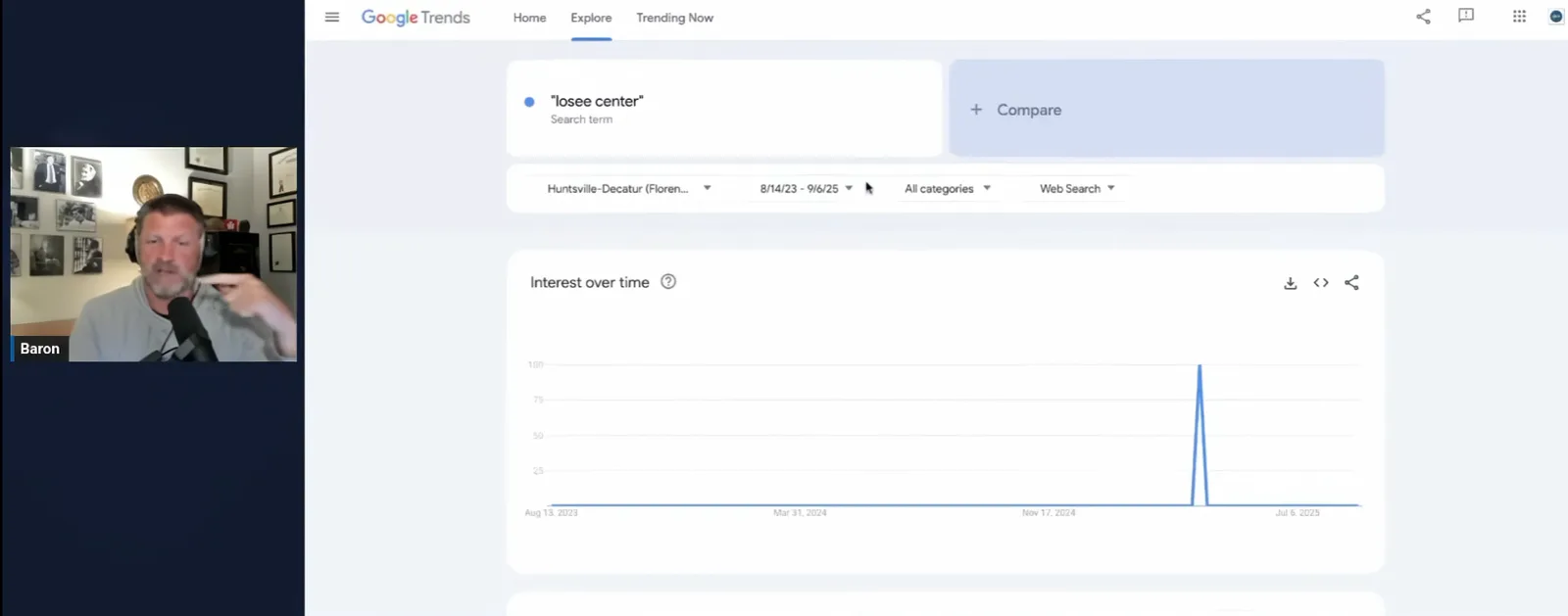
In the weeks after Charlie Kirk was shot at Utah Valley University on September 10, 2025, posts began to circulate showing Google Trends charts. Each chart had a flat line with one or two sharp spikes dated before the shooting. The search terms were the name of the man later charged, a campus building named in coverage of the shooting, and the tail number of a private plane. The regions were far from Utah, usually the Washington, D.C. or Huntsville, Alabama metro areas.[8]
The charts are not faked. Anyone can make them. The question is what a spike on one of them means.
What Google says a spike is
Google Trends does not show search counts. It takes a sample of searches, divides each point by all searches in that place and time, and scales the result from 0 to 100. The highest point in whatever window you choose is always 100. Terms with very low volume are shown as zero.[1]
Google also adds random noise to protect privacy. Its help page says the noise is always present and is most noticeable on searches with little or no interest.[1]
“These apparent one-off spikes should not be interpreted as real search activity or evidence of individual searches.”
A Google spokesperson told ABC News in Australia in December 2025 that for very uncommon terms, Trends may appear to show some search interest even if there were no actual searches.[3]
What independent checks found
The same kind of claim spread after the Bondi Beach attack in December 2025, and it was tested. ABC News could not reproduce the spike the posts described. It did get pre-attack spikes when it ran the attacker's name in Mongolia, Japan and Kenya, which it said showed the method is unreliable.[3]
AAP FactCheck found that Trends draws a different random sample each time a query is run, so the same search on a different day can produce a noticeably different chart. It noted that similar claims were made after Kirk's death.[2]
Jacques Raubenheimer, a biostatistician at the University of Sydney who studies Google Trends, wrote that noise can produce strange results on unusual search terms, and that accurate results require combining many samples. He addressed one post about the Kirk case directly, saying its claim of odds of less than one in a billion is incorrect.[4]
AFNPT's own tests point the same way. Using Ana Escobar's settings, about one made-up or rare phrase in three showed a spike somewhere in the window. The same searches run hours apart returned different dates. The full test record is here.[5]
What cuts the other way
- Google's written warning is new. Archived copies of its help page from August 13, 2025 and April 20, 2026 do not contain the passage about statistical noise and one-off spikes. A copy from May 16, 2026 does. The warning was added after the shooting. The earlier page did already say that Trends is a sample and that low-volume terms appear as zero.
- Trends is built from real searches. Google describes it as a largely unfiltered sample of actual search requests. A spike can reflect a real search. The chart alone cannot tell you whether it does.
- In a later case, Newsweek could not find the spikes that posters shared, but did find a low volume of searches for a suspect's name on two earlier dates. It asked Google whether those could be an error or searches for other people with the same name, and did not report an answer.
- No one outside Google has the raw counts. Until Google publishes them or a court obtains them, nobody can say how many searches lie behind any one point.[9][10][11][1][12]
The dates can be off by hours
Google says charts covering seven days or less use the viewer's own time zone, and charts covering 30 days or more use Coordinated Universal Time. A screenshot taken in one time zone, about an event in another, can place a point hours away from where a reader assumes it sits. That matters when the claim is about what happened the day before.[1]
The plane
Many of these posts tie the search charts to a private plane that left Provo about an hour after the shooting. The FBI director addressed it eleven days later.[6][7]
“After interviews with the pilot and consultation with the FAA, we determined the transponder was not turned off. Incomplete flight data in rural areas caused the apparent gap.”
What this means for the court case
Tyler James Robinson is charged with aggravated murder and six other counts. He has pleaded not guilty and is presumed innocent. A judge sent the case to trial on September 1, 2026. Nothing in this article is evidence for or against him. The charges and court dates are here.[13]
Questions people ask
Does a spike to 100 on Google Trends mean a lot of people searched?
No. Google scales the highest point in the chosen window to 100. On a rarely searched term, one sampled search, or noise, can be the highest point.
Can Google Trends show where a search came from?
Only to the level of a country, state or metro area. It cannot show a building, a base or a person.
Why did a spike disappear when someone ran the search again?
Google Trends draws a new sample for each request. On low-volume terms the result can change between runs. AAP FactCheck and AFNPT's own tests both recorded this.
Has any major fact-check desk examined the Kirk search charts directly?
AFNPT found none as of October 13, 2026. AAP FactCheck and The Conversation examined the same method after the Bondi attack and said the Kirk claims followed the same pattern.
Sources
- [1]Google, FAQ about Google Trends data. Official source“This means that for these queries, Trends data will sometimes reflect statistical noise rather than actual search interest.”
- [2]AAP FactCheck, Bondi attacker search data is static, not a conspiracy, December 24, 2025. News report“Similar claims involving the results from the website were made after US conservative Charlie Kirk's assassination.”
- [3]ABC News (Australia), ABC NEWS Verify, Racist and antisemitic false information spreads online following Bondi Beach terrorism attack, December 17, 2025. News report“Trends data may appear to show some search interest even if there were no actual searches.”
- [4]The Conversation (Jacques Raubenheimer, University of Sydney), How misreading Google Trends is fuelling Bondi attack conspiracy theories, December 17, 2025. News report“To get accurate results, one has to aggregate many samples of Google Trends data”
- [5]Americans for Transparency, The Fort Huachuca guest list, checked, October 7, 2026. AFNPT review
- [6]Lead Stories, Fact Check: Private Jet N888KG Is NOT Part Of Investigation Into Utah Assassination Of Charlie Kirk, As Of September 21, 2025, September 22, 2025. News report
- [7]Fox News, FBI Director Kash Patel says agency investigating 'theories and questions' surrounding Charlie Kirk's murder, September 21, 2025. News report
- [8]Distractify, Wild Charlie Kirk Google Trends Conspiracy Theory Raises Major Red Flags, October 16, 2025. Reference
- [9]Internet Archive, Google's Trends FAQ as archived on August 13, 2025, August 13, 2025. Primary record
- [10]Internet Archive, Google's Trends FAQ as archived on April 20, 2026, April 20, 2026. Primary record
- [11]Internet Archive, Google's Trends FAQ as archived on May 16, 2026, May 16, 2026. Primary record
- [12]Newsweek, National Guard Shooting Suspect's CIA Ties Spark Conspiracy Theories, November 27, 2025. News report“did not find the search activity shared by the posters on X”
- [13]Americans for Transparency, State of Utah v. Tyler Robinson: the seven charges and where the case stands, October 13, 2026. AFNPT review